Under the title
Gravitational Radiation Experiments, a major scientific journal published a
report prepared by physicist Joseph Weber of the Princeton Institute for
Advanced Studies in 1970. Weber's article included a synchronous experiment on
two devices located 966 kilometers apart, one in Maryland and the other in
Chicago, Illinois, USA. The two devices captured high-energy radiation waves
flowing from the center of our Galaxy, the Milky Way.
These waves,
unlike those emitted by giant stars, came in the form of violent flashes from
dark places among the crowded stars in the center of the Galaxy. Such waves,
according to Weber's report, had been recorded at least once from various
points where galaxy stars were crowded. Weber's report astounded cosmologists
because such waves are only caused by extremely violent cosmic events. They
concluded that these broadcast points are signals of enormous interstellar
gravity, swallowing all nearby celestial bodies, and that stars that fall into
these spots release those rays captured as final distress calls before
disappearing into the dark spaces between the stars: these super gravity hotshots will be labeled black holes later on.
The results of
Weber's experiment are truly surprising: if a group of celestial bodies
disappears from our natural world every day, as observed, then the Universe
should have vanished long before its birth date. Our galaxy, for example, has
100 billion stars and is approximately ten billion years old. If we assume that
one of our galaxy's stars dies every day at the same rate, the galaxy should
not be older than 55 million Earth years. Furthermore, if the Earth, one of the
galaxy's planets, had been only 55 million years old instead of its true age of
4.5 billion years, intelligent life would never have appeared on Earth, nor
would there have been enough time for dinosaurs to exist, let alone other
living species. More importantly, the observed stability of celestial bodies in
their orbits and orientations eliminates any possibility of the Universe's mass
diminishing, which would be a violation of the law of matter preservation.
Nonetheless, this
does not imply that Weber's findings are incorrect. Let us use the following
example to demonstrate: Consider a laboratory with 100 employees who do not
increase or decrease in number, despite the fact that some of them leave or
pass away from time to time. To explain this, we must assume that the workers
who quit were immediately compensated by others who filled their positions in a
mystery. Similarly, in our Universe, leaking stars appear to be immediately
compensated.
In fact, all
natural laws require that the disappearance of matter somewhere in the natural
Universe be followed by its immediate reappearance elsewhere. That is, the mass
that disappears through a black hole must immediately reappear somewhere else.
Some scientists
believe that white holes must exist in order to validate the principle of
cosmic symmetry in the Universe. A white hole is a strange cosmic object that
emits intense light and causes matter to flood rather than disappear. In other
words, it's the inverse of a black hole. Unlike black holes, however, there is
no agreement as to if white holes exist, or how they would form. They are
predicted by Einstein's theory of gravity, and are most frequently mentioned in
the context of wormholes, in which a black hole acts as the entry point to a
tunnel through space and time, ending in a white hole somewhere else in the
Universe. However, Einstein's theory predicts the existence of a so-called
singularity at the centre of black holes - a state of infinite gravity that
would prevent anything from passing through to the white hole on the other
side.
Some theorists
believe that combining Einstein's theory and quantum theory leads to a new way
of thinking about white holes. Instead of being the 'exit' from a wormhole,
they could be a slow-motion replay of the original black hole's formation.
When an old
massive star collapses under its own weight and forms a black hole, the process
begins. However, quantum effects occurring near the black hole's surface
prevent further collapse to a singularity and instead begin to gradually
transform the black hole into a white hole spewing out the original star
matter. Because the process is so slow, we may have to wait a long time to find
out if white holes exist.[1]
The appearance of
matter out of white holes in a manner opposite to its disappearance in black
holes is known as anti-collapse, and many scientists use this term to describe
the birth of stars as the opposite process of ingesting them in the black hole.
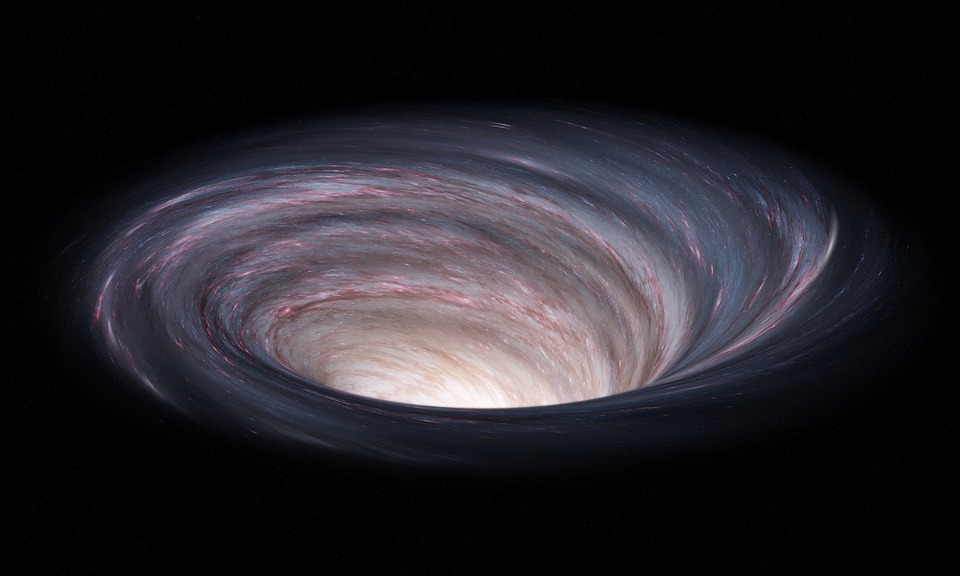
As shown in the
figure below, the Schwarzschild geometry, which describes the space-time
geometry of empty space surrounding any spherical mass, necessitates a large
passageway connecting the black hole to the white hole and thus connecting the
two separate Universes. The Einstein-Rosen bridge is the term applied to this
passage.
The
other end of a black hole
The vast cosmic
distances that separate galaxies and stars give the impression that traversing
these distances in search of habitable planets appears impossible, even if
future technology allows for travel at the speed of light, which is the maximum
speed possible in the natural world. Such journeys would take billions of years
to complete. During the journey, everything could change: for example, the
climate of the planet from which the journey began could become hostile,
leaving travelers with no place to return to, or the entire targeted planet's
position could change, making it inconvenient to settle. Science fiction
authors frequently depict journeys through Einstein-Rosen bridges as a single
real-time jump between two points that are millions or even billions of light
years apart, which eliminates the need for a travel time, or as a series of
jumps that achieve the same result. Could that possibly happen in the future?
Professor of
theoretical physics at the University of Oregon Stephen Hsu told LiveScience
that "the entire thing is very hypothetical at this point.[2]
"No one thinks we're going to find a wormhole anytime soon."
According to an
article published in the Journal of High Energy Physics, wormholes have two
mouths connected by a throat (2020). The mouths are almost certainly
spheroidal. The throat could be a straight stretch, or it could wind around,
taking a longer path than a more traditional route would.
Certain general
relativity solutions allow for the existence of wormholes, the mouths of which
are black holes. A naturally occurring black hole, however, formed by the
collapse of a dying star, does not produce a wormhole.
The reality of
wormholes is more complicated than science fiction, and we have yet to find
one.
The first concern
is one of dimension. Primordial wormholes are believed to exist at microscopic
scales of 10-33 centimeters. However, as the Universe expands, some may have
been stretched to larger dimensions.
Another issue is
one of stability. Because Einstein-Rosen wormholes collapse quickly, they are
useless for travel.
"Some very
exotic type of matter would be required to stabilize a wormhole," Hsu explained,
"and it's not clear whether such matter exists in the Universe."[3]
But more recent
research found that a wormhole containing "exotic" matter could stay
open and unchanging for longer periods of time.
Exotic matter,
which should not be confused with dark matter or antimatter, contains negative
energy density and a large negative pressure. Such matter has only been seen in
the behavior of certain vacuum states as part of quantum field theory.
If a wormhole
contained sufficient exotic matter, whether naturally occurring or artificially
added, it could theoretically be used as a method of sending information or
travelers through space, according to Live Science. Unfortunately, human
journeys through the space tunnels may be challenging.
An
imaginary wormhole
Wormholes may not
only connect two separate regions within the Universe, they could also connect
two different universes. Similarly, some scientists have conjectured that if
one mouth of a wormhole is moved in a specific manner, it could allow for time
travel.
"You can go
into the future or into the past using traversal wormholes,"
astrophysicist Eric Davis told LiveScience. But it won't be easy: "It
would take a Herculean effort to turn a wormhole into a time machine. It's
going to be tough enough to pull off a wormhole[4]."
However, British
cosmologist Stephen Hawking has argued that such use is not possible.
"A wormhole
is not really a means of going back in time, it's a shortcut, so that something
that was far away is much closer," according to NASA's Eric Christian.
Although adding
exotic matter to a wormhole might stabilize it to the point that human passengers
could travel safely through it, there is still the possibility that the
addition of "regular" matter would be sufficient to destabilize the
portal.
Today's
technology is insufficient to enlarge or stabilize wormholes, even if they were
found. However, scientists continue to explore the concept as a method of space
travel with the hope that technology will eventually be able to utilize them.
"You would
need some super-super-advanced technology," Hsu said. "Humans won't
be doing this any time in the near future."
Is there any
evidence, which indicates that white holes or wormholes really exist?
Some quantum
physicists believe that supernovae, in which giant stars end their lives with a
massive explosion visible from millions of light years away, are actually
radiation from white holes, as are bursts recorded by ground observatories from
outer space from time to time. They are a signature of a black hole that once
swallowed matter and spewed it back through a white hole, but it is still too
early to be certain, and more experimental evidence is needed to confirm the
existence of white holes.
Once it happens,
then we'll be able to expand our understanding of the past and future of the
Universe in which we live, and perhaps even take advantage of this phenomenon
in real-time travel between universes, worlds and galaxies.
It is striking that
the Holy
Quran does not explicitly mention instantaneous space travel as we understand
it today. However, there are verses that some interpret as alluding to rapid or
extraordinary travel. One such verse is:
Surah Al-Isra (17:1): “Glory be to
Him who made His servant (Prophet Mohammad) travel by night from the Sacred
Mosque to the Farthest Mosque, whose surroundings We have blessed, to show him
some of Our signs. Indeed, He alone is the All-Hearing, All-Seeing.”
This verse refers to the Isra and Miraj,
the night journey and Ascension of the Prophet Muhammad (peace be upon him),
which is often interpreted as a miraculous event involving rapid travel1.
. Robert Matthews, what is a white hole? Science Focus Magazine.
. Adam Hadhazy, Science Fiction or Fact: Is Wormhole Space Travel
Possible? LiveSience, published February 23, 2012
. Nola Taylor Tillman, Ailsa Harvey, What is wormhole theory?
Space.com, published January 13, 2022.
Jillian Scharr, Wormhole Is Best Bet for Time Machine,
Astrophysicist Says, LiveScience, published August 26, 2013.



Comments
Post a Comment