The Celestial Canopy: What wondrous form does our Universe embrace?
In an audacious quest to unravel the architecture of our cosmos, a consortium of scientists from the United States, Canada, and Germany embarked on the most extensive computational endeavor in history, necessitating the deployment of a supercomputer[1]. This behemoth of a machine was inundated with a vast array of data pertaining to over ten billion galaxies, inclusive of intricate details about nebulae and the dispersion of dark matter throughout the Universe. Despite its formidable computational prowess, the supercomputer labored for an entire month to process this data, ultimately conjuring an image of the Universe that resembled an intricately woven tapestry.
The image
depicted below offers a glimpse into a cubic segment of the Universe, a
simulation meticulously crafted by the supercomputer. A detailed scrutiny of
this image reveals a fascinating pattern: galaxies are not randomly scattered
across the cosmic expanse. Instead, they align along precise filaments, each
potentially extending hundreds of millions of light-years. This cosmic lattice,
formed by these filaments, has been aptly named the ‘galactic network’ by
scientists.
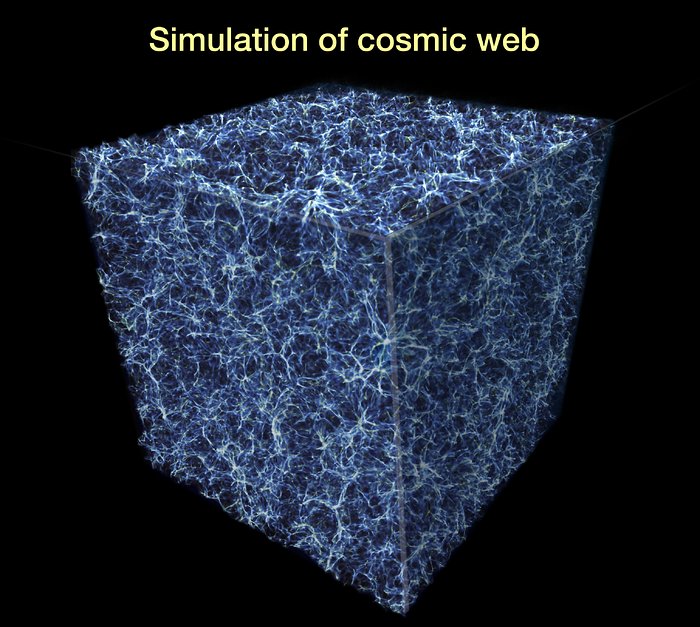
The cosmological
simulation above is in a 700 Mpc co-moving[2]
distance of the Universe.
The filaments of
this plot converge at radiant nodes. These nodes are dense conglomerations of
hundreds of galaxies, known as galaxy clusters. Given that each galaxy is home
to an average of 100 billion stars, we can deduce that these galaxy clusters
are vast repositories of billions of stars, varying in size, with some dwarfing
our sun, which is merely a medium-sized star.
The dark matter
that envelops galaxies exerts a unifying effect, binding them into a cohesive
system. Each of these clusters can be likened to a tower, with individual
galaxies serving as the constituent blocks. The immense mass of the cluster
exerts a gravitational pull on the galaxies strung along the plot’s filaments.
These galaxies, drawn towards the cluster, either collide with other galaxies
or merge with the cluster’s galaxies, thereby becoming an integral part of it.
The filaments of
the plot can be visualized as cosmic highways leading to bustling nodes. Isn’t
it awe-inspiring to contemplate the intricate beauty and grandeur of our
celestial canopy?
In verse 7, the Qur'an alludes to the intricate structure of the heavens,
invoking a sense of wonder and contemplation:
"By the heaven containing pathways..." (Surah Adh-Dhariyat; 51:7)
This verse invites us to ponder the cosmic architecture—the celestial
highways that crisscross the sky. Imagine these pathways as cosmic threads,
weaving through the vastness of space, connecting stars, planets, and galaxies.
Each pathway carries its own purpose, its own celestial choreography.
In scientific terms, we recognize these pathways as the orbits of celestial
bodies—the graceful arcs traced by planets around the sun, moons around
planets, and galaxies within galactic clusters. These orbits are governed by
the laws of physics, harmoniously balancing gravitational attraction and
centrifugal force.
The Qur'an invites us to contemplate the interconnectedness of all
things—the delicate balance that sustains our universe. Whether we gaze at the
night sky or study the equations of astrophysics, we find ourselves tracing
those heavenly pathways, seeking understanding and awe.
So, let us marvel at the cosmic dance—the silent symphony of orbits—and
recognize that even in the vastness of space, there lies a divine order, a
purposeful design.
[1] . A supercomputer is a
computer with a high level of performance as compared to a general-purpose
computer. The performance of a supercomputer is commonly measured in
floating-point operations per second (FLOPS) instead of million instructions
per second (MIPS). Since 2017, there are supercomputers which can perform over
1017 FLOPS (a hundred quadrillion FLOPS, 100 petaflops or 100 PFLOPS).
For comparison, a desktop computer has performance in the range of
hundreds of gigaflops to tens of teraflops.
[2] . A mega parsec is a
measurement of distance equal to one million parsecs or 3.26 million light
years. Mega parsec is usually abbreviated as Mpc. Co moving distance factors out
the expansion of the universe, giving a distance that does not change in time
due to the expansion of space.


Comments
Post a Comment