In Search of a Hidden Universe
It has been
demonstrated since 1929 that the Universe is expanding, that is, the distance
between any two given gravitational unbound parts of the observable Universe
is increasing with time.[1]
It is an intrinsic expansion in which the scale of space changes. The
Universe does not expand "into" anything, nor does it necessitate the
existence of space "outside" it. This expansion does not involve
space or objects in space "moving" in the traditional sense, but
rather the metric that governs the size and geometry of space-time evolving in
scale.
As the spatial
part of the Universe's space-time metric increases in scale, objects become
more distant from one another at ever-increasing speeds. To any observer in the
Universe, it appears that all of space is expanding, and that all but the
nearest galaxies (which are bound by gravity) recede at speeds that are
proportional to their distance from the observer.
Scientists once
predicted that the Universe would continue to expand against its own gravity,
creating a spontaneous backward gravitational force that would gradually force
the expansion to stop when it reached a certain limit and then draw the
compartments of the Universe (stars, moons, planets) back on themselves,
similar to how when we throw a football up, it first speeds up, then gradually
slows down until it stops, then begins falling backwards again.
In fact, the
celestial bodies are constantly accelerating farther from each other. This
acceleration increases proportionally with their distance increase from the
centre of the Universe, which is supposed to be the centre of the cosmic
gravity – the farthest of these bodies at the edge of the visible Universe
(i.e., about 13.8 billion light years away) are flying away at an extraordinary
speed almost as fast as the speed of light. What drives these galaxies away
with such an enormous speed? Twenty-first century scientists have found
themselves after all the tremendous development in scientific and technological
possibilities at the puzzle.
There must be a
cosmic force superior to the force of gravity that can push galaxies with such
superpowers. Scientists have called this force Dark Energy because it is a
force that could not be seen but only realized through its impact on celestial
bodies. Even more strange is that this energy forms most of the Universe we
know.
Much amazing is
the fact that we see through our observatories and astronomical binoculars,
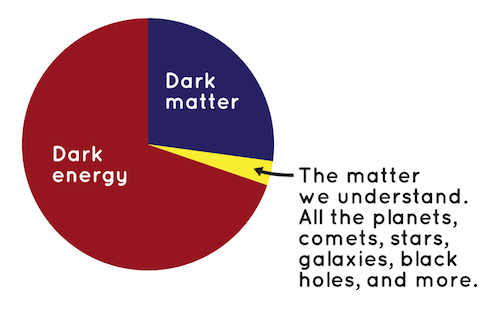
which rely on the greatest technology known in history, not more than 4% of the
Universe, of which 0.4% are star matter and 3.6% cosmic dust distributed in the
sky between stars and galaxies, while dark energy, is believed to constitute
about 73% of the known Universe.
Dark matter was
known a few years before dark energy, which is a material that does not
interact with light to become visible and accounts for about 23% of the
remaining physical Universe, as shown in the following figure:
Scientists
believe that dark energy is one of the characteristics of cosmic space; it
cannot be reduced or faded as the Universe expands; rather, the larger the
Universe, the greater its dark energy. This result may be difficult to grasp:
the first principle of thermodynamics states that energy must be preserved,
which means that the energy of any isolated system must remain constant and
cannot arise from nowhere. However, evidence of increased acceleration of
celestial bodies as they diverge shows that dark energy is constantly
increasing.
In the annals of scientific discovery, the
year 1916 stands as a pivotal moment—a juncture where the fabric of our
understanding of the cosmos began to stretch and expand. At the heart of this
revelation was none other than the brilliant physicist Albert Einstein, whose
groundbreaking work in general relativity had already transformed our
perception of space, time, and gravity.
Einstein's field equations, elegant
mathematical expressions that encapsulated the curvature of spacetime in
response to mass and energy, yielded an unexpected consequence: an expanding
Universe. Yet, Einstein, ever the skeptic, hesitated to embrace this emergent
Universe. His intuition recoiled at the notion of a creation event—an origin point
for all that exists.
In a daring move, Einstein introduced the
cosmological constant—a term within his equations—to counteract this cosmic
expansion. This constant acted as a cosmic brake, attempting to maintain a
static Universe, akin to a celestial equilibrium. However, observations by
astronomers, notably Edwin Hubble, revealed that galaxies were hurtling away
from one another, like cosmic seeds scattered by an unseen hand. The Universe
was not static; it was dynamic, evolving, and inexorably expanding.
Einstein, humbled by the evidence, famously
referred to the cosmological constant as his "biggest blunder." He
abandoned it, acknowledging that the Universe, as far as it is continuously
expanding, demanded a beginning—an epoch when time itself ignited. In this
surrender, he glimpsed the presence of a superior intellectual power—an
architect of cosmic extents.
Thus, the expanding Universe became a
cornerstone of modern cosmology—a testament to both scientific curiosity and
the delicate dance between reason and wonder. Einstein's journey from
reluctance to acceptance echoes through the ages, reminding us that even the
greatest minds can stumble upon profound truths."
Recently,
scientists have resurrected Einstein's cosmological constant (denoted by the
Greek capital letter lambda) to explain dark energy, a mysterious force that
appears to be counteracting gravity and causing the Universe to expand at an
accelerating rate.[2].
According to the researchers, a new study confirms that the cosmological
constant is the best fit for dark energy and provides the most precise and
accurate estimate of its value yet[3].
The discovery stems from a measurement of the Universe's geometry, which
indicates that our Universe is flat rather than spherical or curved. Christian
Marinoni and Adeline Buzzi of France's Université de Provence discovered a new
way to test the dark energy model that is completely independent of previous
research. To measure the curvature of space, they use distant observations of
pairs of galaxies.
"The most
exciting aspect of the work is that there is no external data that we plug
in," Marinoni told SPACE.com, meaning that their findings aren't dependent
on other calculations that could be flawed.
The researchers
probed dark energy by studying the geometry of the Universe. The shape of space
depends on what's in it? That was one of the revelations of Einstein's general
relativity, which showed that mass and energy (two sides of the same coin) bend
space-time with their gravitational force.
Marinoni and
Buzzi set out to calculate the contents of the Universe -- i.e., how much mass
and energy, including dark energy, it holds -- by measuring its shape.
There were three
main options for the outcome:
The Universe can
either be flat like a plane, spherical like a globe, or hyperbolically curved
like a saddle. Previous studies have favored the flat Universe model, and this
new calculation agreed.
By providing more
evidence that the Universe is flat, the findings bolster the cosmological
constant model for dark energy over competing theories such as the idea that
the general relativity equations for gravity are flawed.
"We have at
this moment the most precise measurement of soft lambda that a single technique
can give," Marinoni said. "Our data points towards a cosmological
constant because the value of the lambda we measure is close to minus one,
which is the value predicted if dark energy is the cosmological constant."
Unfortunately,
knowing that the cosmological constant is the best mathematical explanation for
how dark energy is stretching out our Universe doesn't help much in
understanding why it exists at all.
"Many
cosmologists regard determining the nature of dark energy and dark matter as
the most important scientific question of the decade," wrote Alan Heavens of Scotland's
University of Edinburgh in an accompanying essay in Nature. "Our
picture of the Universe involves putting together a number of pieces of
evidence, so it is appealing to hear of Marinoni and Buzzi's novel technique
for testing the cosmological model, not least because it provides a very direct
and simple measurement of the geometry of the Universe."
So, given this
new discovery, what is the Universe's future? The second principle of
thermodynamics explains how events in the world change using a concept known as
"entropy," an expression indicating that events always change in one
direction towards the future, as indicated by an arrow pointing to the future
on the axis of time; we call such a change irreversible (i.e., events cannot
take place in the direction of the past).
In other words,
if we leave nature to its own devices, it tends to be random and chaotic. For
example, if an earthquake occurs and the letters from a printing press are
scattered on the ground, these letters will almost certainly not form
Shakespeare's poetry. The randomness of events is related to the number of free
choices available, or Freedom Degree; for example, the number of random numbers
produced by throwing two dice is much lower than that produced by throwing five pieces.
The change in
events from lower entropy to higher entropy is a state of degeneration and
decline in creation perfection; a fresh egg is in a lower entropy state or
ordered state and a cracked or scrambled egg is in a higher entropy state or
disordered state. This process is irreversible, which means we can't restore
the cracked egg into its original form again. A raw egg exemplifies the
asymmetry of time; which means, time flows in one direction forward, we could
also say: the broken egg has a higher entropy.
Scientists
believe dark energy is responsible for changing the world in a single
irreversible direction.[4]
Dark energy causes chaos and randomness, leading to the end of the Universe.
Dark energy is
pushing the Universe outwards, consistent with its expansion continuing
forever, leading to The Heat Death or Big Freeze, which is an end to
astrophysical activity marked by increasing isolation, inexorable decay, and an
eons-long fade into darkness.
Dark energy
accelerated expansion could also lead to the Big Rip, where stars, planets, and
atoms will be ripped apart.
Not to worry,
though, whatever it looks like, the end probably won’t be nigh for at least 200
billion years[5].
In the sacred text of the Quran, a profound reference is made to the vastness of the cosmos in Surah Al-Dhariyat, Verse 47 (51-47). It eloquently states,
"With formidable might, we have built the heavens, and indeed, we are the
ones who continue to unfold its vastness."
Meanwhile, the Quran also contemplates the potential end of the universe in Surah Al-Infitar, verses 1 and 2 (82:1,2). It paints a vivid picture of a cataclysmic event, possibly akin to what modern science refers to as the 'Big Rip'. This event could cause the very fabric of the cosmos to rupture, leading to the scattering of celestial bodies. The verses read,
"When the heavens are
rent asunder, and when the stars disperse in all directions."
These
verses not only reflect the grandeur of the universe but also its transient
nature, reminding us of the delicate balance that holds everything together.
They beautifully encapsulate the infinite expansiveness of the cosmos and its
potential dissolution, resonating with some of the most profound theories of
contemporary astrophysics.
[1] . Overby, Dennis (20
February 2017). "Cosmos Controversy: The Universe Is Expanding, but How
Fast?". The New York Times. Retrieved 21 February 2017.
[2] . Clara Moskowitz, Einstein's 'Biggest Blunder' Turns Out to Be
Right, SPACE.com, published November 24, 2010.
[3] . Cosmology: geometry of the universe.
Heavens A, Nature. 2010 Nov
25;468(7323):511-2. doi: 10.1038/468511a.
[4] . Time arrow is influenced by dark energy, A. E. Allahverdyan and
V. G. Gurzadyan, Phys. Rev. E 93, 052125 – Published 13 May 2016
[5] . Nature 584, 187 (2020).


Comments
Post a Comment